| Mon
Book Info
Subscribe
| |||
Dear Reader, I used to be afraid to ask questions. And if I found the courage, I'd preface my query with, "I know this is probably a dumb question, but..." Or, if I was talking to someone--and before they launched full-force into their conversation--they looked at me and said, "You're familiar with Torison fields, aren't you?" I'd nod yes, and periodically give them cues that I was with them all the way. But I was clueless--nope, not an inkling of what they were talking about. But now I always ask questions--and so does my husband. The first time we came to Florida, my husband and I were visiting old friends. They'd made dinner reservations at a fancy restaurant, and when I was perusing the menu, I noticed fresh lobster was one of the specialties. I love lobster, but since it's pricey, I don't eat it very often. There wasn't a price listed, but this was a special occasion, so I thought I'd ask the waiter the price when he came to take our order. "I don't want you asking about the price," my husband insisted. "Just order the lobster. We're on vacation, go ahead and splurge." I tried several times to change his mind, but he said it would be too embarrassing to ask. I think he was operating on the old saying, "If you have to ask, then you probably can't afford it." "How expensive could it possibly be?" was his final remark. $78.65--and the baked potato was extra. Thanks for reading with me. It's so good to read with friends. Suzanne Beecher P. S. This week we're giving away 10 copies of the book White River Crossing: A Novel by Ian McGuire. Click here to enter for your chance to win. | |||
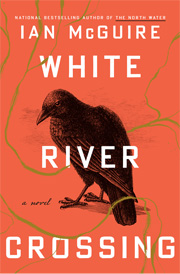
White River Crossing: A Novel | |||
Part One Prince of Wales' Fort, a Hudson's Bay Company Factory on the Churchill River January 1766 Chapter One Patterson the pedlar is clad in a suit of greasy winter hides; he has a dark woolen cap pulled low over his ears, and beneath the cap's ragged fringe his eyes are narrow and close-set and the skin of his cheeks and brow is red raw in patches and scrofulous. When John Shaw sees him standing there next to the battened well in the center of the narrow cobblestone courtyard with his savage-looking cur steaming beside him, he knows from his sly and thievish looks alone just what he is without needing to ask. The pedlars are pirates and brigands who scavenge off the lawful fur trade. Between them and the Hudson's Bay Company the rivalry is long and bitter, and so to find one bold or foolish enough to visit a factory uninvited is rare. When Shaw asks him to state his business plainly, Patterson says that he has come to speak to the chief factor, Mr. Magnus Norton. "I won't take much of Mr. Norton's precious time," he explains, calm and unabashed, as if such an intrusion is commonplace, "but I have something special to show him, something that he'll wish to see." "And how would a man like you know what Mr. Norton wishes to see?" Patterson shrugs and rubs his nose with the back of his snot- blackened mitten. "I hear Norton's a clever fellow. And this thing I have is something a clever fellow will want to know about." "We don't do any business with pedlars," Shaw warns him. "It's not the furs I'm speaking of now," he says. "It's something other.&quoquot; "Then show me what you have." Patterson flinches at the thought, then shakes his head. "No, I can't do that," he says. "Not out here. It wouldn't be right." John Shaw, who has been Norton's deputy for as long as anyone can remember and is not a man widely known for either his graciousness or his patience, is inclined at first to direct this intruder back to whatever ramshackle and shit-smirched trading post he's journeyed from with clear instructions not to return on pain of a whipping. But there is something in Patterson's demeanor that gives him pause. Later on, when the truth is known, he will claim it was a second sense, a feeling in his balls or his bones. He will say in his usual boastful way that he knew it from the first, but at the time all he really thinks is that there's something queer about this fellow Patterson and before he sends him packing, Magnus will want to know about it. "Have you met Mr. Norton before?" he asks him. Patterson shakes his head. "But the Indians I trade with vouch for him. They say he can be trusted." "And who, pray, will vouch for you?" Patterson smiles again as if the two of them are sharing a private joke. "What I have in my pack here will vouch for itself. You'll see." Shaw gives him a long unfriendly stare, then tells him he will speak to Norton. "In the meantime, you can chain that dog and follow me," he says. "I don't want you loitering about the courtyard bothering the other men or causing trouble." They walk over to the men's house and go through the hallway and into the common room. Shaw points to a rush-bottomed chair by the stove, and Patterson sits down with a sigh and takes out his pipe and his tobacco pouch. Edward Hutchins the surgeon and William Cure the shipwright are in the room already, playing at cribbage for a ha'penny a point. Patterson starts to introduce himself, and Shaw tells him to keep quiet until he's told to speak. "You're on Company land now," he says. "So you'll play by Company rules." Patterson looks amused more than offended by this display of strictness. He makes a somber face and puts his right forefinger up to his lips. "Hear no evil, speak no evil," he whispers gaily. "I understand you, Mr. Shaw, and you won't hear another word from me until I'm asked for my opinion. I can promise you that." * * * Magnus Norton, chief factor, a man who, in his own estimation and that of most in the know, understands more about the Hudson's Bay fur trade than any other soul living or dead, has no more love for the pedlars than John Shaw—perhaps less, since for the last ten years, their unsanctioned trading has cost him at least two thousand made beaver each season—but he is shrewder and less impulsive than his deputy, and when Shaw tells him who is here, he reasons that if a man has taken the trouble to travel so far in the wintertime, then he must have some story to tell. He instructs Shaw to give Patterson a bowl of soup to eat if he's hungry and after that they will hear whatever it is he has to say. When Shaw is gone, Norton blots the last page of the ledger, gets up from his desk, and goes across to the fireplace to warm his hands. As he stands there by the andirons, he glances about the room with its brass lamps and tapestries and oil paintings of dogs and horses and feels, as he usually does, a sense of quiet pride and satisfaction in all he has achieved. He arrived on the Bay fifty years ago with nothing in his pockets, a poor and ignorant youth, and he has raised himself up to this prominence through hard work, relentlessness, and guile. He has grown old now, that cannot be denied. Unclothed, the skin sags off his bones in loops and folds like the melted tallow of a candle, and when he notices his face in the looking glass, he wonders sometimes who is the old fool looking back? But his urge to make a profit, he can say with surety, is undiminished. He has made him- self rich already (there is no other place so splendid as this one for a thousand miles all around, he is quite certain of that fact), yet still, every day, like the rack-ribbed boy he once was, he yearns to be richer. After a quarter of an hour has passed, there's another knock on the door and Shaw steps in from the courtyard, followed by Patter- son. The pedlar, whose stench precedes him, takes two steps forward, then stops where he is and gazes about the room with his mouth agape. Norton is well-used to this reaction; he's seen it before more times than he can count. The bemusement first, then the wonder that such a place—a palace, some have called it—should exist in this otherwise barren wilderness. It is a fine way, he always thinks, to begin any conversation: by reminding the other fellow of the kind of man he's talking to. "That couch over there is from Paris," he says, calmly nodding, "and the rug you are standing on is from Constantinople. I have an agent in London who picks them out on my behalf, a Mr. Alderton." Patterson peers down at the swirling red and green patterns between his boots, then looks up again and scratches his head. "I heard you were something different," he says. "That's what I heard." Norton, feeling satisfied with this remark, nods, waits a while longer to allow the fixtures and furnishings to achieve their full ef- fect, then moves over to his desk and seats himself. "Mr. Shaw says you have something to show me," he says. "Some- thing you claim is of great value." "Aye, I do indeed." "As you can see, I'm hardly short of rare and precious objects." "This thing I have ain't wrought by any human hand," he says. "I don't like to boast, Mr. Norton, but I'd say it puts all your fancy foreign geegaws here in the shade." "You show some respect," Shaw says. Norton raises his hand for calm, then looks at Patterson with a strained smile. "You're not short of boldness, I can see. Why don't you just tell me what it is you have so I may judge for myself?" Patterson, by way of reply, reaches into his gunnysack and removes a package about the size and shape of a penny loaf wrapped in hessian and tied about with twine. He hands it to Norton. "I didn't believe it either," he says. "Until I saw it for myself with my own two peepers." Norton takes the parcel and puts it down on the desk beside his ledger. He unfolds a pocketknife, cuts the twine, and peels away a part of the covering. Underneath is a large piece of stone, so far as he can see, dark gray and white in color. "I had you for a pedlar," he says, "not a quarryman." "It's more than that," he says. "Look closer." Norton shakes his head and glances up at Shaw, who only shrugs. It occurs to Norton that this Patterson may have gone a little mad from staying too long out in the woods in the dark and cold of winter with only Indians for company. Living like that can turn a man's wits; it's a well-known fact. God knows, Norton has had to confine his share of lunatics over the years. He unwraps the stone completely and leans forward. It's a squarish block of dark granite, just as he thought, with a diagonal band of white quartz blazoned across it. Nothing special, he thinks. He's about to ask Patterson what on earth he means by making such an offering, but then, as he looks closer, he notices that the pale quartz is shot through with a pair of thin and branching yellow lines, like twin rivers marked on a survey map. He stares down at the lines for half a minute without moving or speaking at all. Then he reaches into a drawer, removes his magnifying glass, and raises it to his eye. Shaw, watching, senses that something has just happened. No one is speaking, but the silence has a sudden weight to it, like the still air before a storm. "What is it?" he says. Norton beckons him closer and hands him the glass. "Just there." He points. "Tell me what it is you see." John Shaw was a tinner for three years in the Ladock stream works in Cornwall before he came out to the Bay. It was wearying work for slender reward—pushing barrowloads of shoad uphill or standing knee-deep in leat water all day long. He would have quit it much sooner than he did except that some few days of every year, perhaps once every two or three months, when he was working down in the tyes, rinsing off the leavings to reveal the black ore, he'd see a fleck of something else lying in the water among the pebbles of granite and feldspar, just a glimmer or a blink, nothing more. But a morsel of gold, however small, will catch the light and hold it like nothing else on this earth. Shaw had the eye for it then and he has the eye for it still, so when Norton beckons him closer, he doesn't need any mag- nifier because, right away, he can sense what it is; he can feel its deep, silent calling like a thrill in his blood. "Where did you find this?" he says to Patterson. "I got it from a Chipewyan fellow I know." "And where did 'he' find it?" Patterson grins and rakes his fingers through his long red beard, then gazes around the room with a gleeful look on his mottled face. "I knew you'd change your tune quick enough when you saw it," he says. "I knew you would. You had me down as a fool and a wastrel, but now it turns out I'm the man you've been dreaming of all your long lives." "You've taken us by surprise," Norton says. "I can't deny that. We've all heard the stories about gold fields to the north, about men who went looking but never came back." "This ain't a story or a rumor, though, is it?" Patterson says, cutting him off. "This is the thing itself. Pure and true." (continued on Tuesday) Love this book? Share your review with the Publisher
| |||
| Mon Book Info | |||