| Mon
Book Info
Subscribe
| |||
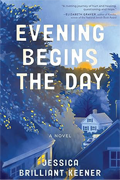
Dear Reader, Today's guest author is Jessica Keener. Her bestselling debut novel, Night Swim, was followed by her collection of award-winning stories, Women in Bed. Her second novel, Strangers in Budapest, was an Indie Next pick, a Southern Independent Bookseller Association bestseller, and a "best new book" selection by Entertainment Weekly. Jessica's brand new book is Evening Begins the Day: The story weaves together two families in crisis--one reeling from a marital betrayal and the other grappling with their at-risk teenage daughter--with an ancient spiritual practice called The Counting of the Omer; a modern-day quest for community, hope, and safety. Jessica is giving away three copies of Evening Begins the Day. To enter the drawing, drop her a note with your preferred shipping address: jessicakeener1@gmail.com
Welcome back to the book club, Jessica Brilliant Keener... Last year, after spending the afternoon in downtown Boston, I got on the trolley and headed home, stopping first at Trader Joe's to get a few groceries. But when I got to the cash register and reached for my wallet in my backpack, my wallet wasn't there. It was gone. In a panic, I ran outside and retraced my steps back to the trolley stop. Maybe I'd dropped it on the street? No such luck. Within minutes, the next trolley arrived. Feeling frantic, I hopped on and told the driver I had just lost my wallet. Had anyone reported it? "Nothing yet," she said, and told me I could go to the Lost & Found office at the end of the line, about 6 stops away. In the meantime, I called the manager at Trader Joe's. Did anyone find it in the aisles? Sadly, no. At the Lost & Found office, which was basically a shed in a parking lot, the woman working there made a few calls. Nothing. Walking home, my mood plummeted. I'd have to cancel my Visa cards, call my medical insurance company, replace my driver's license— That's when my husband called. "I have your wallet!!" "What???" "A woman dropped it off. She found it on the ground, near the trolley stop across from Trader Joe's." He went on to explain she was the same woman we often saw jogging around the neighborhood--a short, petite woman with dark curly hair. I knew exactly who she was. The summer before, I'd stopped in front of her apartment building to compliment her stunning sunflowers bordering her small yard, but we never exchanged names. She lived half a mile away from our condo.
"What's her name?" "Margie." Thrilled and relieved, I bought a bouquet of flowers, wrote my phone number on a card, and left them in the foyer of her building because I didn't know which apartment was hers. A few hours later, she texted me to thank me for the bouquet. I called her back, gushing, "You're a miracle! You saved my day! My week!" "I love finding things for people," Margie said, laughing. "It gives me so much joy." Now, whenever I recall that incident, I am reminded that there are so many good people in the world like Margie. They're not making headlines. They're simply helping strangers and neighbors--honestly, without fanfare--every single day. -- Jessica Brilliant Keener Jessica is giving away three copies of Evening Begins the Day. To enter the drawing, drop her a note with your preferred shipping address: jessicakeener1@gmail.com Thanks for reading with me. It's so good to read with friends. Suzanne Beecher P. S. This week we're giving away 10 copies of the book The Shock Of The Light: A Novel by Lori Inglis Hall. Click here to enter for your chance to win. | |||
The Shock of the Light: A Novel Listen to a clip from the audiobook Watch a "World War II in Fiction" Author Panel Featuring Lori Inglis Hall | |||
The first time the twins are separated is birth. The boy is born first, howling, red-faced, lashing out at the doctor. His hands are searching for the other—his mother Adela sees this; how lost he is without his twin. The girl is born soon after, more pink than red, and calm. The midwife places her next to her brother, who clasps her hand and stops crying. Everyone laughs at the sudden silence except Adela, still prostrate in bed. She is trying to comprehend what has happened, the change, the stinging between her legs. "Would you look at that," says Dominic, from the doorway. He goes to the crib, despite the midwife trying to usher him away, birth being no place for the father, after all. He places his hand on the girl's chest, smiling. He has always longed for a daughter. "Mother and babies all well," says the doctor, packing his bag, not looking up. Adela has found his cold, brisk manner at odds with the experience. How can something so transformative be dealt with so curtly? She will never understand the English and their ways. In France, she's sure they would have let her scream. There is a flash. Dominic taking the first photograph. The picture is framed and placed on a mantelpiece in the same room as the crib where the babies are clutching hands, legs entwined, not a sliver of light between them. Their father names the girl Tessa, for Hardy's Tess. The boy he leaves for his wife, who names him Theo after her father. She pronounces it the French way, as her father did, the way that feels natural on her tongue—'Théo', with a hard T—but no one else will. In time, more photographs join the first. Here are the twins at school in the smart blazers of the local grammar, where Theo uses his brain and Tessa learns how to make a home, furious at the injustice of it. Here they are climbing trees, swimming in the river; the land is theirs, they've claimed it. Theo in his academic gown, Tessa in Paris, her arms full of books, smile blazing. In the fields beyond the house in which they grow, crops rise and fall with the turning of the earth. They were linked by a single thread but now the thread divides, two twins, two lives. As the space between the twins widens, they don't notice it at first. The light that stands between them. PART ONE TESS Paris, 1938 ONE Tessa is crouched at the top of the narrow stairwell leading up to her bedroom, which she's always called a 'garret' in letters to her brother, if only for the romance of it. She runs her fingers over the new line of her stomach and cranes her neck. It is a colossal pig's ear of a mess. 'Disaster' feels fitting. 'Catastrophe' better still. Downstairs, her landlady is on the telephone. Through the spindles of the banister, Tessa can make out Madame Vernier's expression as she strains to hear the voice crackling across the Channel from a house 500 miles away. 'No, I don't know when she'll be back. Yes, I passed on your message. No, I have no message for you. Désolée.' She is struggling to get a word in edgeways. Tessa knows the voice on the line will be barking questions, as it has throughout her childhood. Her mother will be crouched on the stairs too, in Cambridge, the wall next to her lined with family photographs. The stairwell in which Tessa is hiding is covered in yellow paper, which in places is torn, peeling back on itself in little wave-crests. Through a window no bigger than her head she can see the rise and fall of grey-tiled rooftops, and beyond, the spire of the great cathedral on its island. She had always wanted to live in Paris, the city in which her mother grew tall. She told her mother the truth a week ago, when she could no longer ignore the nausea and the tightness of her waistband. The most god- awful telephone conversation, which she'd realized within minutes should have been a letter. Her mother was certain she knew what to do—certain, but quietly so, meaning Tessa's father must have been nearby. This morning the letter in her hands arrived, written in English to ward off prying eyes, repeating all the things her mother had said on the telephone. 'We will go away for a time', her mother wrote, 'arrangements are underway'—but all without further elucidation, leaving Tessa to wonder briefly if a page was missing. 'Your father is not to know', her mother went on, and then—'nor Theo.' But Tessa tells her brother everything, it is the twins' way. Then she thinks, no—it 'was 'their way, because she hasn't told him. This is another break with the past, the first being her move to Paris three years ago...The acceptance letter from the Sorbonne on the table, Theo pacing up and down in the parlor. The blazing row. "How could you?" he'd hissed. She couldn't look at him, couldn't bear the desperation in his voice. The twins had never spent more than a few days apart. "I thought we'd agreed," he said. "Cambridge. We both said we'd stay. Law for me, Literature for you. We said we'd do this together." Tessa snatched up the letter, reading it again, unable to believe it was real. "I didn't say that," she said. "You did." Time, that great healer, will repair the rift between them. But if Tessa keeps something from her brother again, she knows it will change everything. Impossible to think otherwise—if she shuts him out, he might not come back. At school, a girl in their final year had fallen pregnant. Of course no one was told, but all the signs were there. The weight gain, the sudden disappearance from class, the girl's mother pushing a pram a few months later. Everyone knew the child wasn't hers. Tessa had listened as her peers passed judgment, along with her brother. She remembers his words in particular: "Girls like that, they can never escape the shame. It lingers like a bad smell." He probably hadn't meant it to be cruel— but it was, it was. It still has its sting now. Her mother is right. Theo cannot find out. He'd never look at Tessa in the same way again. Besides, the point of coming to Paris, of the life she'd sought, was that it was just hers, something she'd no obligation to share. The city in its entirety has been an education. Has it been the same for Theo, she wonders, still in Cambridge? He'd put a few miles between himself and their parents. She'd put an ocean. Now look at the state of everything. Twenty-two years old, and with nothing to show for it but this god-awful mess. Her mother is certain it cannot be undone. She won't hear about the doctor Tessa found, carbolic soap and a hook. It is too late for that, her mother says. In the hallway below, Madame Vernier has her hand to her mouth, her staccato French changing, softening. 'I know, we never stop worrying for them, do we? They never seem grown to us.' Yes, thinks Tessa, I am a bad daughter, I know. Her mother had wanted to know about the father, and Tessa almost answered, almost reached for the obvious. Luc doesn't even know. He wouldn't understand. Luc is a sensation on her skin like the sun, he is heat. Tessa had wanted to say, I love him, I loved him—I did, I swear. 'Until.' Her hand is on her belly, and how queer they are, these instincts, this need to protect something she doesn't want and never ever asked for. Already her silhouette is changing, her belly rounding beneath her breasts. 'Finish your studies', her mother wrote, 'it's only a few months. For God's sake, hide it.' Tessa lets go of her belly, twisting her skirt into a knot, because how simple her mother makes it sound, this shifting of the earth. Downstairs, Madame Vernier hangs up the phone and Tessa treads silently back upstairs. A great shame, her mother called it. Oh yes, Tessa thinks, that's exactly what this is. * * * Cambridge, 1942 TWO Tessa is always the fastest and bravest—it is a matter of pride (though her brother might call it recklessness). She is the first to reach the top of the oak tree, where from the tallest branches the land's divide is clear: rooftops one way, a great stretch of green the other. Her victory is simply one of technique, because while Theo climbs steadily—one foot, one arm, other foot, other arm— Tessa swings her way to the top. On the terrace below, her parents' friends are gathered around her father. 'Fifty', she hears one say, 'but you've only just been born!' A group of girls she'd known at school are hovering by the edge of the lawn, where she can hear them laughing and chatting. Lily is there. Years ago they'd been as thick as thieves, only now Tessa can't remember the last time they had a conversation. Lily is married now, has children, Tessa knows that, at least—how different their lives have become. Go over, join in, her mother had said, but since Paris she's forgotten how. Her schoolfriends raise their hands and wave, and she pulls her lips into a smile, quickly looking away in case it's mistaken for an invitation, knowing that the old Tessa would have rushed over, full of tales and escapades. In the midst of it all her mother is fussing over the lunch spread. Tessa is reading her lips, watching her direct and explain; perhaps she thinks the concept of a buffet is beyond her friends. For a quick second their gazes meet and her mother falls silent, her hands caught in a gesture in mid-air. Tessa is astonished her mother can look her in the eye. Theo is laughing when he finally appears beside her. "Typical Tessa," he says. "I took it as slowly as I could." She's unable to hide her teasing smile. "Wanted to give you a fighting chance." (continued on Tuesday) Love this book? Share your review with the Publisher
| |||
| Mon Book Info | |||