| Mon
Book Info
Subscribe
| |||
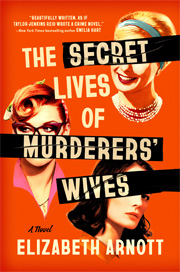
Dear Reader, If you like pistachio or are looking for a green dessert for your St. Patrick's Day table, this recipe sent in by Jennifer G. may be just the recipe you are looking for. She also sent in another dessert recipe, that you may have to read to believe. She said, "These are definitely my go to recipes for celebrating St. Patty's. My other most favorite is a good Reuben sandwich! Eat well and take care!" – Jennifer G. Pistachio Orange Coffee Cake Recipe Cake Ingredients Filling Ingredients Glaze Ingredients Instructions Second recipe: Thanks for reading with me. It's so good to read with friends. Suzanne Beecher P. S. This week we're giving away 10 copies of the book The Secret Lives of Murderers' Wives: A Novel by Elizabeth Arnott. Click here to enter for your chance to win. | |||
The Secret Lives of Murderers' Wives: A Novel | |||
TWO "Ladies and gentlemen," the emcee's voice booms, "welcome to the LAPD's annual family-and-friends gala evening, 1966." Beverley feels as if her heart has dislodged itself and oozed down into her stomach. "To get us started, please welcome"—someone has stuffed sandpaper into her mouth—"Chief Tom Cornwell, head of the California Major Crimes Investigation Unit." The crowd applauds. She slips into a spot at the side of the stage that is crammed with shadows but has a clear sight line to the audience. People watch intently, low light refracting off their diamond jewelry, as Cornwell strolls into the spotlight. It occurs to Beverley that men like Tom Cornwell have no cause to be nervous, because they are so often the default heroes, so often able to control the narrative, to tell others what they should be thinking of them. So, what does that make her? A villain? An accomplice? It has been almost five years since it all happened, but she has still not figured out quite where she fits into the story. A wife? Sure. A woman existing in a torturous duality? Most certainly. Someone close enough to a killer to know the smell of their neck, the sighing noise they make in their sleep, the fact that their bottom-left canine tooth is black from a run-in with a baseball bat. But someone so close to a killer that she could not step back and see it, so wrapped up in the mundanity of her life that she was very easily played. "Ladies and gentlemen," Cornwell begins. Beverley sees shoulders straighten at his imposing voice, the same voice that questioned her, that bombarded her with the horrific intricacies of Henry's crimes. "Thank you for having me here tonight to celebrate another year of successes at the Los Angeles Police Department and beyond." Still no smile. "I'm proud to have the opportunity to speak about one of the most pivotal moments in my career." It's about him. It's always been about him. "Five years ago, after an investigation that demanded unprecedented resources, the support of every county sheriff's office in the state and the hard work of my staff and my deputy, Roger Greaves, I placed handcuffs around the wrists of Henry Lightfoot, a man who terrorized the good residents of California for over three years. A brutal spree that earned him the name the Heatwave Killer." He pauses, and it takes a moment for the audience to realize they are expected to clap. What must it be like, Beverley wonders, to stand before a roomful of people and demand that they applaud you? Cornwell fixes his tie, flexes his jaw, basking in the sound, before quieting the room with his hands. "I can still remember"—the audience is transfixed—"the way my heart raced when my fingers brushed his skin. It was like touching pure evil." Beverley swallows. "And, actually"—he raises a finger—"while that might have been the most pivotal point in my career"—he glances briefly into the shadows—"my proudest moment is right now, right here"—he points to his feet—"tonight, because tonight I am blessed to be welcoming a remarkable woman to this stage." She could leave. She could turn and run before anyone could stop her. "Mrs. Beverley Lightfoot, ladies and gentlemen." 'It's Edwards now. Miss Edwards.' "Wife of the Heatwave Killer." 'Ex-wife.' "The woman who worked openly with the police to help secure a conviction for her husband." 'Define 'openly'.' Suddenly the lights are on her, and she sways a little, dizzy from the ambush. She squints, her hearing blunted by white noise, flashes of the afternoon it happened hot in her skull. The handcuffs. The helicopters. 'Bandstand' on the television. Teenagers dancing to Neil Sedaka's "Little Devil"; she still remembers the song. Images reel by. The sunlight, golden at that hour, slanting in through the window. The heat of the casserole dish through her oven mitts, the ones with rabbits. Ceramic smashing into a hundred pieces on the floor. "We can chase criminals all we want," Cornwell continues, "but only brave women like Beverley Lightfoot know what it's like to share a life with one, and with 'that' sort of information, that sort of insight into the lives of murderers, shared by women like this one right here, we can help build a picture of these dangerous men and what they do behind closed doors." She can smell him then—Henry—what he used to smell like when he crawled back into their bed late at night. She swears the scent still lingers in her nostrils, Old Spice and engine oil. She'd slide herself over to where he lay and curl herself across his back like the shell of a pill bug. "So, without any further ado, here's introducing to the stage the remarkable Mrs. Beverley Lightfoot." The applause is deafening. She can see, among a celestial burst of brightness, the whites of their watching eyes. Somehow, she steps toward the microphone at the center of the stage. As she nears it, she reaches out for it. The seams of her dress are digging in at the base of her neck. The bow is too tight. She pictures neat, red indentations in her skin. She'd wanted to help—that's all—to try to stop there being more victims. That is why she had said yes. That is why she is here. But she is finding it almost impossible to remember how to speak. Someone clears their throat. She gulps. "Good evening." The microphone shrieks. She recoils, glances to the side of the stage and sees Cornwell watching her intently. She steps to the microphone again, not too close this time. Lowering her eyelids against the light, she takes a deep, audible breath. "Good evening, ladies and gentlemen. My name is Beverley . . . Lightfoot. I was the wife of Henry James Lightfoot, who, between 1957 and 1961, killed seven women in the Bay Area of California. This is my story." The applause is a roar as she leaves the stage. She is not quite sure how she has done it, but she has, and were she not so numb from the effort, she might consider that it has gone well. Cornwell nods reluctantly as she moves past. Then he turns his head as an officer calls out from the bottom of the steps. "We're headed back to the precinct, Chief," the man says, eyes lingering on the lipstick stain on Beverley's dress. "There's been an incident." He assesses her as if weighing whether she should hear what he is about to say. "We've got a body. You're not going to want to miss this one. It's . . . unusual." THREE "Have you tried bleach?" Margot calls from her reclined position atop a pool float. Her head is pounding, the sun casting bright cobweb patterns through her eyelids. She flops an arm to the side and allows her fingers to graze the water's cool surface, quivering blue and gold. She really shouldn't have drunk so much last night, but she didn't know that Tony Curtis would show, and he's always a devil with the Gibsons. She paddles her way to the ladder, pulls herself out of the water and stands for a while, allowing the day's molten heat to dry her limbs. By her toes, a tiny salamander idles, licks its eye. The air is replete with heat-woozy honeysuckle and a chemical whiff of chlorine. The kitchen doors have been pulled wide, and the tinny sounds of the Beatles leak out from the radio. "Paperback Writer." She hates that cutesy song. She wraps a towel around her waist, sits, wonders if someone might fetch her some Tylenol if she looks pathetic enough. "She's right," says Elsie. "Lipstick should shift with bleach. Just soak it, hang it on the line. It'll dry in no time." "Kids, stay where I can see you!" Beverley hollers suddenly. Margot's head snaps up with a crick. Benjamin and Audrey, who have been chasing each other relentlessly around the lawn, freeze and nod dumbly at their mother. "I 'really' don't think I should be airing my dirty laundry for the neighbors." Bev turns back to them, adjusting the straps of her polka-dot one-piece. "It's not a good look for me." "Honey, I'd be more worried about that creep at number forty-four ogling your underwear." Margot pulls a copy of the 'LA Times' from her purse and rests her sunglasses on the top of her head. "That's not nice." Elsie's British accent barbs the admonishment. "We don't judge people like that." "We do if they are creeps," Margot replies, overly loudly, turning the pages of the newspaper. "That's when we do judge, Elsie." Margot glances at Beverley, hoping for a laugh, but her friend seems distracted, probably thinking about what happened at the gala last night. She was so nervous in the run-up to it. In fact, Bev's been nervous about everything of late. She wasn't jittery like this when they met, four years ago. When Margot first laid eyes on Beverley, she'd felt a stab of jealousy. Bev was younger than her, but that wasn't really the issue. She was also beautiful, with that maddening sort of beauty that just seems to happen. Beverley didn't even need to try. Her whole family looked like something from the pages of 'Ladies' Home Journal'; it was all too easy to picture them gathered at a bowling alley or slurping through straws at a malt shop. Margot worked hard on her own appearance—getting her hair set, wearing makeup, investing in the expensive face creams she'd heard Liz Taylor used. It was a cultivation, a tending to a garden that could so very easily turn. Bev had baggage, sure, and it extended way beyond the fact that her husband was a killer. Margot had clocked it a mile off: daddy issues, the need for a man to control her. That was why, Margot knew, Bev was most rattled by her husband's being put behind bars. Never mind what he did to that girl with a fire poker. There was now no one left to tell her what to do. (continued on Tuesday) Love this book? Share your review with the Publisher
| |||
| Mon Book Info | |||