| Mon
Book Info
Subscribe
| |||
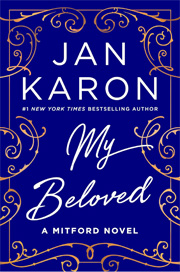
Dear Reader, The quality of writing in the Write a DearReader Contest was outstanding. Today's Honorable Mention piece was written by Margaret Orleans. Thank you very much Margaret for sharing your story with us. You've certainly given me some ideas… Elaborate airport welcomes have been a big thing in my family for decades. I’m not sure who was greeted at the first one, but I have fond memories of the planning that went into meeting my brother-in-law when he could finally break away from work and join the rest of the family on vacation. One time we were his fan club, and dropped a banner from a railing above the escalator that took all the passengers to the luggage carousels. We screamed and cheered for him, and when his wife shouted, “Marry me!” several other passengers agreed to do that. – Margaret Orleans Suzanne Beecher P. S. This week we're giving away 10 copies of the book My Beloved: A Novel by Jan Karon. Click here to enter for your chance to win. | |||
Pen in hand and his notebook open before him, he was ready to do what he did every November: Get started on his Christmas list. He had vacated the French desk in the study and adopted the kitchen island as a command center. At the east end of the island, he wrote letters, paid bills, stashed his laptop, and kept a handy trove of books. The west end was reserved for culinary pursuits. When Cynthia cooked, he often read aloud to her from Mary Oliver, Billy Collins, Wendell Berry, or, out of long affection, George Herbert and Wordsworth. Early on, they agreed that poetry paired well with food prep, fiction worked best after dinner, and nonfiction was for reading alone, silent as a monk. By seven-thirty a.m., he had prayed with his wife, checked his sugar, had his shot, and polished off his stone-ground oatmeal with raw honey and multigrain toast. This upbeat start on the morning had made him over-confident—his pen was poised but nothing was happening. The grand expectation of churning through the list was morphing into a muse. He considered the books spilling out of their allotted space and encroaching on the laptop. Back in the day, which seemed a cool hundred years ago, he'd been a bachelor priest in his slip-covered wingchair, avidly reading through a pile of books. Books were his friends, his family, his mode of travel, his relief from the woes of the vestry. Somehow, and certainly not by his own effort, he'd gone from a bachelor with blood kin consisting of one lone cousin, Walter, to a family his cousin called 'humongous.' While such a family delivered equally humongous dividends of pleasure, his reading time had taken a hit. Before Cynthia, he'd been unmoored by the prospect of sharing his time with a wife. How much of his time could a wife possibly need? Now he knew and he did not regret even a minute with his cheerful, artistic, and beautiful wife. He was unmoored no more; but settled in. In a groove, you might say, though definitely not in a rut. And there was Dooley—not of his blood, but of his heart. At the age of eleven, Dooley had landed on his doorstep, a thrown-away boy— barefoot in shredded overalls, with a mouth that a mother of yore would have washed out with soap. Call it a miracle that today his adopted son—now a successful veterinarian with his own practice— had a beautiful, artistic wife himself. And two kids that he and Cynthia were over the moon about. A phenomenal string of events had cast him in roles he'd never dreamed of fulfilling—father, husband, father-in-law, brother, brother-in-law, great-uncle, grandfather. There was Jack, a lovable seven-year-old mash-up of cowboy boots and imagination, and Sadie, going-on-three-year-old who had taken down every defense in her grandpa's arsenal. He'd never given his heart so freely. With Cynthia, he'd fought giving his heart. There was the inarguable fact that he'd already given it to God—though only to a certain degree, as he later realized. That had seen him through a decades- long passage until he had a revelation: God's love for his children wasn't just for them to have and to hold, it was to freely, spontaneously give away—and to gratefully receive from others. Why hadn't he understood this before? That awakening had opened both his heart and his intellect to a sober realization—while he'd spent years being afraid to love, he'd been far more terrified of receiving it. He had begun at once to work these truths into daily practice. Not easy. And not overnight. But the process had performed its share of miracles—had, in fact, at the tender age of sixty-two, gotten him married. His abandoned French desk, given him recently by a former parishioner, now displayed an archive of framed family photos. There was Dooley and Lace's Sadie, miraculously born to a mother long pronounced unable to conceive. A few years ago, he learned he had a half-brother. Out of time and despair, hope and prayer, Henry—a brother. They both resolved to drop the 'half' business. He and Cynthia had attended Henry's Holly Springs wedding—an event that gave him a witty and agreeable sister-in-law. He studied the wedding photograph, searching Henry's face for any resemblance to his own. Zero. But they both loved poetry and starched handkerchiefs and letters written in cursive. He had a laugh at the memory of taking Henry by the shoulders, looking him in the eye, and saying, 'Brother, I forgive you for being taller and better-looking.' To go from a family consisting of a cousin to the present-day slew was a sea-change, calling for a new way of dealing with Christmas giving. In years past, he had made a list. Now he must make A List. Cynthia breezed into the kitchen in a vague cloud of her signature wisteria scent. 'You wear perfume for the grans?' 'Jack says he loves the way his Granny smells—it makes him sneeze. He also loves making his own picture book. You'll see it soon; it's about bugs. When he turns all that talent loose in the world . . . wow! How about your Poetry with Grandpa syllabus?' 'I need one more run through the town library. Poetry for three- year-olds is scarce.' As Lace's mural-painting commissions increased, she needed help with the kids. He and Cynthia were giving a hand when Lily Flower was otherwise employed. His wife was applying lipstick without the aid of a mirror. It was his job to give a thumbs-up if she hit the mark. She hit the mark while eyeing the kitchen island. 'Could you clean some of the stuff off the counter?' she said. 'It runneth over.' 'I was just thinking that.' 'I'm making pasta for the weekend and . . . ' She gestured. ' . . . all those Billy Collins books.' 'But you love Billy Collins.' 'I'm crazy about Billy Collins, but not when I'm making pasta, which takes up gobs of room.' 'Consider it done.' She gave him a smooch on the cheek. 'Love you, sweetheart.' 'Love you back.' 'Are you off to the hospital?' 'Tomorrow.' 'See you at five, then. Could you pick up a lemon for tonight?' 'Will do. Anything else, give me a shout. Love to the kids. Tell them I'll be out soon.' 'Ooops, I got lipstick on your cheek.' 'Leave it. I'm branded.' And away she flew, eager for what life had to offer. He had always started his Christmas list with the nurses. Who could make it without nurses? Not the doctors, not the patients. How many years had he spent plowing up the hill to visit the ever-changing stable of patients, assisted by nurses in his labors of consolation? Even the sour ones had their place in the scheme of things. And didn't nurses love chocolate? Wasn't that their favorite thing to go home to even if they had a husband who was good-looking and would carry out the garbage? But the rules had shifted when he wasn't looking. He'd been told that what nurses want now is gift certificates. Nurses want to choose their chocolate themselves. Good for nurses for speaking out and taking charge! Five gift certificates for chocolate. It felt good just getting that on paper. Unlike his free-ranging wife, he enjoyed the boundaries imposed by a list. He would save his wife 'til last on the list because she required more than a bit of head-scratching. 'Don't buy me anything,' she said just yesterday. 'I have everything I could possibly want or need. Just write me a love letter. Please, honey.' He loved it when she called him honey. He remembered the Year of the Bathrobe—he had searched for one- hundred-percent cotton with pockets—she favored pockets—and matching slippers. Though he was convinced he had a homerun, she had seemed . . . what? Dismayed wouldn't cover it. A more recent Christmas gift had its own downside. According to rule, they agreed to give each other one gift only—no cheating by giving more. It had to be utilitarian, and they had to keep mum so it would be a surprise. She liked surprises. They had ended up giving each other the same thing—a smoothie blender. The same make and model. Surprise all around! Hers, however, had been on sale and she had saved thirty bucks. Which meant that he'd be returning the one he bought. All he had to do was hike to the recycle bin in a freezing rain and retrieve the box and dig through the foam peanuts that went berserk all over the place and locate the shipping label and the form that asked why the item was being returned, to which he replied It's a long story, and then rewrap the blasted thing and schlep it to the UPS drop-off. Looking back, his own biggest want had once been for a world globe, and she had been thrilled to give him one. Years later—six or seven, maybe—he was still perfectly satisfied with his globe. Lighted. In a mahogany stand. How could he want more? 'I'd love to give you something you'd really, deeply enjoy,' she said yesterday. 'Something that would make you feel, I don't know, seventeen again?' 'I have her,' he said. She seemed to like that argument, but still . . . Since they married, he'd written a love letter or two. The one in which he plagiarized a passage from Duff Cooper had been a hit. Cooper had enjoyed a career of writing torrid love letters to his wife, Diana, before dying at sea in '54. But the letter currently under consideration would have to come entirely from his own striving. Gus was awake and panting at his feet. The red leash that his hundred-and-ten-pound Bouvier had worn was of course too large for a rescue of thirty-three pounds soaking wet. He had punched a few holes and used his leather cutter to nip the excess. Out they went into the mountain fog. So far, November was an unseasonably warm month, not cold enough for a fire on the hearth. This weekend would be different; the temperature was predicted to drop by several degrees, and they had a half-cord of hardwood he was itching to burn. This was ground fog; those headed down the mountain would be driving the first few miles in a cloud. He was a fog fan. And no wonder—he was Irish. Gus also had a touch of the Irish. His dog was fond of music; had once lapped up a spilled Guinness at a Meadowgate party; and was inclined to good humor often resulting in a grin. (continued on Tuesday) Love this book? Share your review with the Publisher
| |||
| Mon Book Info | |||