| Mon
Book Info
Subscribe
| |||
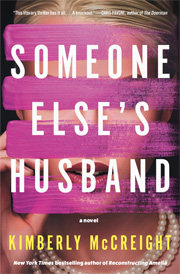
Dear Reader, I never know what day it is anymore. I'm on deadline every day, but it's not for the day I'm on. See how confusing things can get? I'm supposed to write my column at least two days before it's published at the book club, so it can get all tidied up and loaded into a software program in time to show up in your email. So on Monday I'm writing Wednesday, on Wednesday I'm writing Friday, on Friday I'm already into next week. Sometimes things get even more confusing if I'm going on a business trip and I have to write further ahead. Then I'm not in this week, or next week, but in the week after that. And that's probably why I showed up for a doctor's appointment, two weeks early. When the receptionist asked me what day my appointment was supposed to be, I told her, "Today, Tuesday." "No, it's Tuesday, two weeks from now," she pointed out, but I insisted that I'd already traveled through those days.... My husband's been searching for a new high-tech clock that he guaranteed would solve my "What day is it?" problem. It's not a 'tell you what time it is clock', it only displays the day of the week. When my husband first saw it in the magazine he said he thought it was a stupid idea. Who in their right mind would need such a thing? (And then he thought of me.) But I'm an old-fashioned kind of girl and I think I've found an old-fashioned solution instead. When I was a kid, everybody wore them, "Day of the Week Underwear". Monday through Sunday, each pair came in a different pastel color and the day of the week was decoratively stitched on the outside left-hand corner. It's perfect. I'll always know for sure what day of the week it is because my underwear goes everywhere I go. Want to know what day it is? Hang on a second, let me check. Thanks for reading with me. It's so good to read with friends. Suzanne Beecher P. S. This week we're giving away 10 copies of the book Someone Else's Husband: A Novel by Kimberly McCreight. Click here to enter for your chance to win. | |||
Someone Else's Husband: A Novel | |||
PROLOGUE Getting away with it. That's what people call it. Because when you do something ter-rible, it follows you. Forever. Even when no one ever catches you, blames you, finds out—there really is no escaping the truth. Maybe that's because you never imagined that you'd be capa-ble of such a thing. That kind of violence. Look, even now, how mealy-mouthed you are about it. That kind of violence. So polite. But you murdered someone in cold blood. There's no getting around that fact. Premeditated? No. That's part of the story, too. But when you let yourself remember that night, you feel the rage cours-ing through your body, so hot it could have melted your skin. It was an act born from pure fury. So, no malice aforethought. But hardly an accident, either. Justified? You're not even sure what that word means anymore. You are far from the only person to blame, though. There were other people involved, the bloodshed an inevitable result of too many strong feelings at cross-purposes. Of love—in the wrong forms at forbidden moments. A collision course of fates. And so you can distance yourself from each step that led up to the exact moment of violence, but not the moment itself. Not your part in getting there, either. Certainly, you had a role. It could have ended so differently, too. But you were reckless. You all were, and now you've paid the price. It's easy to forget that we are all just animals in the end, grunting and huffing and struggling to survive. It's our base instincts that get us in trouble. Lust, rage, love, jealousy—not reason. Not rational thought. So much blood, though, my God. You never once thought about what it would be like to kill someone, except abstractly. The way everyone does. Could I do something like that if I had to? To save my own life? To protect someone I loved? To guard what was mine? But who really considers the details? How hot the blood will be on your hands, how strange it feels when it sprays your face. That it will spray in the first place. How it will look on the white bath-room tile after you've smeared it with a rag, because right after it happens, before the horror has fully sunk in, you will be thinking you can clean up the mess. You will be thinking you can make the whole thing go away. When you find you cannot, you run. From it, from yourself. Maybe you land somewhere on the far end of the world. Spar-kling canals on one side, a colorful city on the other. A safe haven, a hiding place. Freedom. But then you realize: You may have gotten away, but you're still with it. Or, rather, it's still with you. Wherever you go, it'll be there, living inside of you. Forever. Even now, sitting here in the warm spring sun, your eyes fixed on so much beauty, the horror of that night still sits in your chest. Some nights, as you lie alone in the dark, you can almost feel it beating like a second heart, nestled right up next to your own. AFTER GRETCHEN September 12 Gretchen was terribly cold, even with the fleece she'd thought to grab. The thin cotton pajamas she was wearing underneath were just, well, too thin. And the police station thrummed with supersonic air- conditioning. Overkill, even with the worst of the summer heat and humidity still smothering New York City like a damp, foul-smelling blanket. Perhaps this was a tactic the police used—freezing people into confessing. She suspected the East Village precinct was nicer than others. It had clearly been remodeled. The lovely historic facade retained, but the interior fully modernized. It was harsh and sterile, though, with fluorescent lighting, cold linoleum floors, and too much steel. The whole place also smelled of some chemically lemon cleaner, which, while nauseating, was probably better than many alterna- tives. Still, three hours of inhaling it was far too much. But that's how long Gretchen had been sitting on an uncomfortable metal bench, ignored, as uniformed officers milled about, along with a handful of men (and one woman) in dress pants who must have been detectives. Everyone had been calm and polite, at least. Even the extremely intoxicated young man in handcuffs who'd been brought in wearing an oversize hooded sweatshirt and very baggy jeans had nodded Gretchen's way. Sheepishly, too, as though she were his disappointed fifth-grade teacher. Then again, she might have imagined that. At this point, Gretchen wasn't seeing anything clearly. She and Richard had been startled from a dead sleep by the sound of the doorbell. Unfamiliar in their Upper East Side co-op, where people didn't ring your doorbell in the middle of the night. People didn't ring your doorbell at all without permission to come to your door. No, the doormen called up in a civilized fashion from the lobby to announce visitors. And Gretchen's visitors almost always came during regular business hours—dry cleaning, weekly flower arrangements, Fiona the decorator, occasionally her Pilates instruc-tor, Ilya. Friends they were hosting for drinks or dinner. Or the children's friends, back when her kids still lived at home. Now both smack in the middle of their fifties, Richard and Gretchen had lived in the same elegant doorman building on the corner of Fifth and East Eighty-Eighth for the past twenty-two years, over-looking the Guggenheim and just a stone's throw from the Met. They'd moved there when the girls were just ten and eight and Becks not yet born. Twenty-two years of being safely tucked away from the chaos of the world, their life as close to perfect as one could reasonably get. Gretchen knew it. She'd known the whole time how wonderful it was. Not a hundred percent perfect. Nothing was perfect. But their family was good. It was her life's work, and it had all turned out the way she'd hoped—so much warmer and more genuinely loving than her own family. A low bar. Her adult life had ren-dered her childhood a cold and distant memory. And Gretchen had been appropriately grateful. Wasn't that supposed to protect them from this kind of . . . tragedy? Apparently not. The second she had heard the frantic ring-ing of their doorbell—obnoxious, really, given that there was no real emergency—she knew something terrible had happened. It 'was' terrible, as it turned out. But it had already happened. At this point, there was nothing that could be done to prevent it anymore, which made all that noise seem calculated to make them panic. It had worked. Gretchen had bolted upright, heart racing. The kids. That was her first thought. Once you had children, they were forever your first thought. But her children were grown now or, in Becks's case, mostly grown, which meant when tragedy came, it came knocking. Gretchen had put a hand on Richard, warm and breathing steadily in the bed next to her. He had been her second thought. Safe and sound. Thank God. There were another two rings, followed by pounding—five, six times in a row. 'Was the building on fire?' Gretchen didn't smell smoke. She shook Richard, hard. Oh, to be the dad. "Richard," she said loudly. "Wake up! Someone is at the door!" He still wasn't moving. She shoved him and shouted in his ear, "Richard!" Finally, he startled awake. Then another pound on the door. Richard rolled out of bed in his pajama pants and an old Dart-mouth T-shirt. "What's going on?" "I don't know." Together, they raced down the steps of the duplex. Gretchen held her breath as Richard yanked open the door. Five, maybe six uniformed police officers were clustered in the hallway with Joseph, the young night doorman, at the far back, gesturing help-lessly. A tall, slim officer with a wispy mustache was in front. The way he was standing with his thumbs hooked in his belt loops made him look like a male stripper impersonating an officer. "Richard Falk?" Richard blinked and shook his head as if waking from a dream while Gretchen left her body entirely. Such a show of force: One of the children was dead—that must be it. If they never said which one, maybe it wouldn't be real. But she was floating somewhere up near the ceiling now. Too far away to do anything to stop this conversation. Too far away to scream. She opened her mouth twice, but no sound came out. "Are you Richard Falk?" the officer repeated, louder and more insistent. "Yes, yes, sorry," Richard said finally, gripping the back of his neck. "Has something happened to one of our kids?" The room rocked to the side. Gretchen pressed a hand against the wall to stay upright. "No, sir. That's not why we're here." The officer held out a piece of paper. "We have a warrant to search the premises." In the long, confusing moments that followed, Gretchen saw things from a blurry distance, heard them in fits and starts. Rich-ard saying there had to be a mistake, the officers saying he could read for himself. It was all in the warrant. Richard stared at the paper for the longest time, trying hard to keep his face neutral. Gretchen knew the expression of her husband of thirty-four years trying, for her sake, 'not' to have an expression. It was worse than worry. Sweat began to bead on Gretchen's lip. "What is it?" "Frankie is dead," Richard said finally. And when he looked at her, the agony in his eyes was overwhelming. And just like that, Gretchen knew that their life, perfect as it had been, was over. "Who?" Her heart was a bomb pulsing against her breastbone. "Frankie Callahan. From the Kilimanjaro trip. Looks like she's been murdered." He tried to clear his throat. "That's what this seems to be suggesting." She edged closer to see for herself: Murder in the Second Degree; Evidence of items belonging to Frankie Callahan. "What are they doing here, though?" Richard looked dumbfounded. "I have no idea." (continued on Tuesday) Love this book? Share your review with the Publisher
| |||
| Mon Book Info | |||