| Mon
Book Info
Subscribe
| |||
Dear Reader, Sometimes I have to reacquaint myself with me.
Life is moving along fine, I have a routine. I know what's expected of me, but when I take on something new and different and I get into the rhythm of the new thing—suddenly I've forgotten how to do the old.
I've been working on two new projects lately and each one requires a different style of writing. A writing style that's different from my daily column at the book clubs. I like the fact that I'm experimenting and learning new things, but the downside is sometimes when I'm in the "learning curve" of something new, I lose track of who I am, and who I used to be.
Writing my column for the book club is something I do every day--I know that person--it's become part of me. But I’m also working on an idea for a different kind of writing project. And that idea takes me in a completely new and different direction.
But isn't writing just writing? No, apparently not. Because every time I start working on my new writing idea, I end up writing a column. Because that's what I'm used to doing. It's what I know.
And things have gotten even more bizarre. Because the other day when I sat down to write a column, I started thinking, 'What is it that I used to do and how did I used to do it? How do I write a column?’ I'd lost myself temporarily and didn't know where to begin. So I went back and reread some columns I'd written in the past--'Okay, now I remember.'
Successful at one thing, try another and the assumption is--no problem, I can do that too. And I can, and I am, but not without some struggle and apparently a lot of temporary confusion.
Thanks for reading with me. It's so good to read with friends.
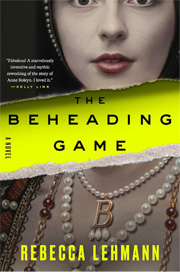
Suzanne Beecher P. S. This week we're giving away 10 copies of the book The Beheading Game: A Novel by Rebecca Lehmann. Click here to enter for your chance to win. | |||
The Beheading Game: A Novel Listen to a clip from the audiobook Watch a “First-Time Fiction” Author Panel Featuring Rebecca Lehmann | |||
PROLOGUE On May 19, 1536, Anne Boleyn, King Henry VIII's second wife, was executed by beheading at the Tower of London for the alleged crimes of adultery, incest, and high treason. Five men, accused of being her lovers, had been executed two days earlier: Sir Henry Norris, Sir Francis Weston, William Brereton, the court musician Mark Smeaton, and Anne's own brother, George Boleyn. Anne and Henry courted for seven years as he negotiated an annulment from his first wife, Katherine of Aragon, with whom he had one surviving child, the Princess Mary. The conflict over the "great matter" of Henry's annulment ultimately led to England's break with the Catholic Church in Rome, setting the nation on a path toward Protestantism. After their long courtship, Anne and Henry were married for only three years, during which time Anne was almost constantly pregnant, as Henry grew increasingly desperate for a male heir. Anne gave birth to one daughter, the Princess Elizabeth; her other pregnancies ended in miscarriage, including the late miscarriage of a baby boy in January 1536. Less than four months later, Anne Boleyn was beheaded. At the time of Anne's execution, Henry had been openly involved in a monthslong affair with her lady-in-waiting Jane Seymour. Anne was the first, though not last, English queen to be executed. At her execution, she delivered the following speech: "Good Christian people, I am come hither to die, for according to the law, and by the law I am judged to die, and therefore I will speak nothing against it. I am come hither to accuse no man, nor to speak anything of that, whereof I am accused and condemned to die, but I pray God save the king and send him long to reign over you, for a gentler nor a more merciful prince was there never: and to me he was ever a good, a gentle and sovereign lord. And if any person will meddle of my cause, I require them to judge the best. And thus I take my leave of the world and of you all, and I heartily desire you all to pray for me. O Lord have mercy on me, to God I commend my soul." The day after Anne's execution, Henry VIII became betrothed to his mistress, Jane Seymour. Most historians today agree that Anne was innocent of all charges. PART ONE Death and Resurrection CHAPTER ONE The Arrow Chest Anne opened her eyes to darkness. And wood. Her face was pressed into the wood. And the left side of her body. She realized fabric as well. A thin fabric that covered her. Linen, she thought, from the smell of it—like wet grass—and the way the air moved through it. Just slightly, for the air here was very still. The linen was wet and sticky. She remembered once wrapping linen around the neck of a stag, whose flank she'd pierced with an arrow, whose throat she'd slit with an ivory-hilted dagger. When the beast had stopped convulsing, she'd draped the gash with linen and played at dressing Christ's wounds. That had been before, when she was young. Her brother, George, had stood beside her, laughing at her joke. She did and didn't remember the two men, servants, who held the dying hart by its horns while she cut its throat. They could have been any men, low class, assigned to serve her. She understood she could move her hands. Movement came to her fingers slowly, in twitches, one finger, then another. She curled them in and out, made fists. She understood now that her arm could move too. Her left arm was pinned beneath her, but her right arm was free. She moved it so her hand, through the linen covering, touched the wood. She felt around, up, down. Wood below, wood before, wood above. Perhaps the wood before her extended to a height of three feet, joined at the corners to the wood above and the wood below. A box, then. She must be in a box. She rapped against the wood once, twice, three times, but no one answered. She rapped the wood above and the wood below. Little hollow knocks. The back of her head was pressed into flesh. Whose flesh? Was some- one else in the wooden box? She blinked her eyes open again, tried to open them wider. Her lids were hard to part. Something crusted their corners shut. Probably the same sticky wetness that she felt on the linen. In front of one eye, a piece of straw. And the linen, wrapped around her, right over her mouth. Its tightness made her want to scream, like being trapped in a bedsheet. She didn't like it. She tried to scream but could draw no air. Or, rather, she could draw air; she could feel her chest rising and falling, but the air was not coming through her nose or mouth. She understood her mouth was shut. She understood her nose was clogged. She opened her mouth, which was dry, and pushed her dry tongue out to touch the sticky linen. It tasted like metal. Her fingers were light. No jewels. Perhaps she had been robbed. Perhaps she had been struck over the head and wrapped in fabric and thrown in a crate, to be ransomed. She used her free hand to feel her body. All around her, linen, encasing her, like a caul. Through the linen, she felt something round and hard. It was at her knees. And large. Her hand went to her stomach, to feel for the roundness that had been there. Her baby. No. She'd lost the baby months ago. She remembered Henry's face when he confronted her in her chambers, in her sickbed. In her birthing bed? No, the child had come early and still. A boy, it had been a boy. The hatred then, in Henry's face. "I see God will not give me male children," he'd said. And his eyes, cold with retribution. No more sympathy. No more love. No more most-cherished one. No more consort. He'd limped around her chamber, stopping before the window, his injured leg bulky with the physician's dressing. To dress a wound was to show care, after all. Who had shown Anne care? She remembered stepping to the stage. The stage was draped in black. And the straw, strewn underfoot, for absorption. No, she remembered being helped to the stage by her ladies, who stood behind her. They must have brought the linen with them. She remembered the good blue of the sky, the blue like a baby boy's eyes. 'Good Christian people,' she'd declared. She'd wanted to say 'my. My good Christian people.' No. They weren't her people anymore. 'Good Christian people. I am come hither.' That one lock of hair that kept slipping out of her cap, that she kept tucking in. Who had shown Anne care? The executioner, dressed so finely she mistook him for a gentleman, who'd let her finish her prayers, who'd danced behind her, moving so quietly from one side of her blind-folded and kneeling form to the other. Who'd misdirected: "Boy, fetch me my sword." She'd turned her head to the sound of his voice, searching for him. 'Je vous cherche;' I look for you. But he'd already danced, silent-footed, to her other side; he already held his sword. As he swung, she searched, unseeing, unaware, in the other direction, no time to flinch, to botch the stroke. And then. And then a terrible pain. And then darkness. How had he moved so quietly on the scaffold? He must have cushioned his shoes, or slipped out of them. So there had been care there. But then what? The good blue of the sky and the dancing swordsman, and now she was here. She understood she was in a box. She understood, then, that the flesh at the back of her head was her own knees. She understood that the round, hard object at her knees was her own head. She felt the back of her head with her free hand as well as she could, because her body was wrapped in one shroud of the linen, and her head in another. How carefully her ladies must have wrapped her body. "Let no man touch me," she'd instructed them. 'Noli me tangere,' she thought, 'touch' 'me' 'not,' recalling the love poem Thomas Wyatt had written for her. For wasn't Thomas Wyatt in some other chamber of the Tower, accused, like the others, of lying with her? 'Whoso list to hunt, I know where is an hind,' he'd written, like so many men who'd wanted to conquer her, or any woman, who'd viewed her as a trinket, a trophy, a deer to master and slay, a mount. So she was awake. Was she alive? Was she a ghost? Was this perdition? She understood her first task was to undo the linen, to untangle herself from the tidy work of her ladies. She shifted her body's weight off her left side so that she could shimmy her left arm out from under her-self. She shimmied and wiggled until her arm was free, until she could press her left hand over her right hand, against her stomach, above her head. 'Good Christian people, I am come hither to die.' She felt for a gap in the linen. There must be a place where the fabric ended, where it had been gathered and tucked in, a loose end. She felt in front of her. Smooth. She did not want to feel above, at her neck. She did not want to know the loss there. She moved her right hand behind herself. There, at her back, a small bulge of tucked fabric, running the length of her body. With her right hand she grabbed a fistful of linen and pulled. It loosened. She pulled again. She wiggled. The linen came loose from around her back. She pulled the sheet of it over and, with small kicks, uncovered her legs, then wiggled her arms and torso free from the shroud. There was the matter, then, of her head. First, next, then, last. She remembered the lesson in sequencing from her childhood. For example, to bake a pie, first, gather the ingredients. Next, make the crust. Then, cook the filling. Last, bake the pie. (Though she'd never baked a pie. She had servants for that.) To grow a garden, first, till the earth. Next, plant seeds. Then, tend the plants. Last, harvest the crop. (She'd never tended plants either.) To become and stay queen, first, go to court. Next, catch the king's eye. Then, marry him (this step took a while). Last, bear a son. She had been so determined, so confident that she'd bear a son. Henry was a virile man in his early forties when they finally consummated their long courtship. How could the child he fathered not have been a boy? But there instead was wee Elizabeth, squalling in her arms. She knew the names people called Elizabeth. 'The bastard. The brat. The little pig.' Her Elizabeth, though she hadn't gotten to keep her long before she was taken, sent off to her own household, to be raised by noble ladies and maids. That was the way of things. 'Ma chere. Mon coeur.' Elizabeth. First, next, then, last. First, learn you are in your own grave. Next, unwrap your headless body from its shroud. Then, unwrap your head. Easy enough. She had two hands free now. She felt the back of her head. She could feel her cap, which had come askew, through the linen. She could feel the place, under the left side of her head, where the linen fabric was tucked. She pulled gently. She could feel the fabric sliding out beneath her cheek, beneath her ear, ruffling her loose strands of hair, knocking her cap off entirely. She could feel the fabric sticking at the nape of her neck, congealed there by her own blood. Panicking, she yanked. The fabric came free, peeling with it the scabbed blood, a bit of the skin beneath. She winced. She understood then that she could still feel pain. "Why the delay?" she'd said to Kingston, the Tower constable, when her execution had been forestalled a day. "He is a good swordsman and I have but little neck." She certainly had but little neck now. She pushed the linen down so that her face was uncovered. She felt the features of her face. All there, all intact. It must have been one blow, then. Swift. Clean. First, learn you are in your own grave. Next, unwrap your headless body from its shroud. Then, unwrap your head. Done. Last, get out of the box. How to get out of the box? She rapped against its side again with her fist. The knock was hollow. A good sign that she was not already buried. That would be more difficult. Unwrapping herself had already strained her. She was sweating. So she could still sweat. With her hands she turned her head to look up at the lid of the box. A faint light shone along one side of the box's lid. On the other side, a hinge. A set of hinges. A box with its lid on hinges. A chest? What if all it took was a push? She shifted onto her back in the box. She put her head on her stomach, looking upward. With both hands, she pushed against the lid of the box, of the chest. The lid moved. The gap of light along the edge grew wider. She pushed again, sitting up as she did so, and opened the lid. Her head rolled into her lap, face down. She couldn't see. But she could feel the air on her collarbones. She picked her head up, held it at chest level. With her hands, she moved her head to the left, then to the right, to take in her surroundings. She was in a stone church. She recognized its modest interior. St. Peter ad Vincula, the Tower chapel. The light that filtered in must be moonlight, because through the windows she could see the night sky. In front of her stood the altar. She tucked her head under her left arm and stepped, carefully, out of the box. She breathed heavily from the work of it. Could you call it breathing? She leaned against the altar to steady herself. Holding her head in both hands, she turned it to look back at the box. She recognized the carvings on its side, ivy and acorns. She remembered it from her hunts with Henry. It was an arrow chest. An arrow chest? They had placed her body in an arrow chest. Were they going to bury her in this arrow chest? She tucked her head back under her left arm and, with her right, swung the lid of the chest closed. It slammed loudly. She hoped there was no one around to hear it. First, discover you are the living dead in your own grave, which is an arrow chest. He didn't even have the decency to plan for a coffin. Next, get out of the box, the chest, your grave, with your head. Then, realize you are still conscious, you can still feel pain, you are still capable of thought. Of anger? Yes, of anger. Last, leave. Leave? Yes, leave. She needed to leave, to flee. (continued on Tuesday) Love this book? Share your review with the Publisher
| |||
| Mon Book Info | |||